

Table of Contents
- Why 12-Hour Shifts Wreck Your Legs
- What Compression Boots Do (and What They Don't)
- Compression Boots vs Compression Socks for Tired Legs
- How Long to Use Compression Boots After a Shift
- Compression Boots Safety and Contraindications
- Leg Recovery Tips for Nurses: Building a Shift Routine
- Choosing Boots: Fit, Features and What You'll Pay
- Conclusion
- Frequently Asked Questions
Last Updated: October 14, 2026
Why 12-Hour Shifts Wreck Your Legs
Compression boots for nurses working shifts solve a specific problem: legs that feel heavy, tight and swollen after hours of standing and walking, often before the shift is even over. If you spend 12 hours on a hospital floor, your calves are doing a low-level workout the entire time.
The mechanics are simple. Standing still or walking on hard floors for hours reduces the pumping action that normally moves blood back up your legs. Fluid pools in the lower limbs. Many nurses describe the feeling as legs that have "turned to concrete" by the last hour of a shift.
What most guides miss is that this isn't a fitness problem you can train away. It's a circulation and recovery problem, and it repeats every single shift.
What Compression Boots Do (and What They Don't)
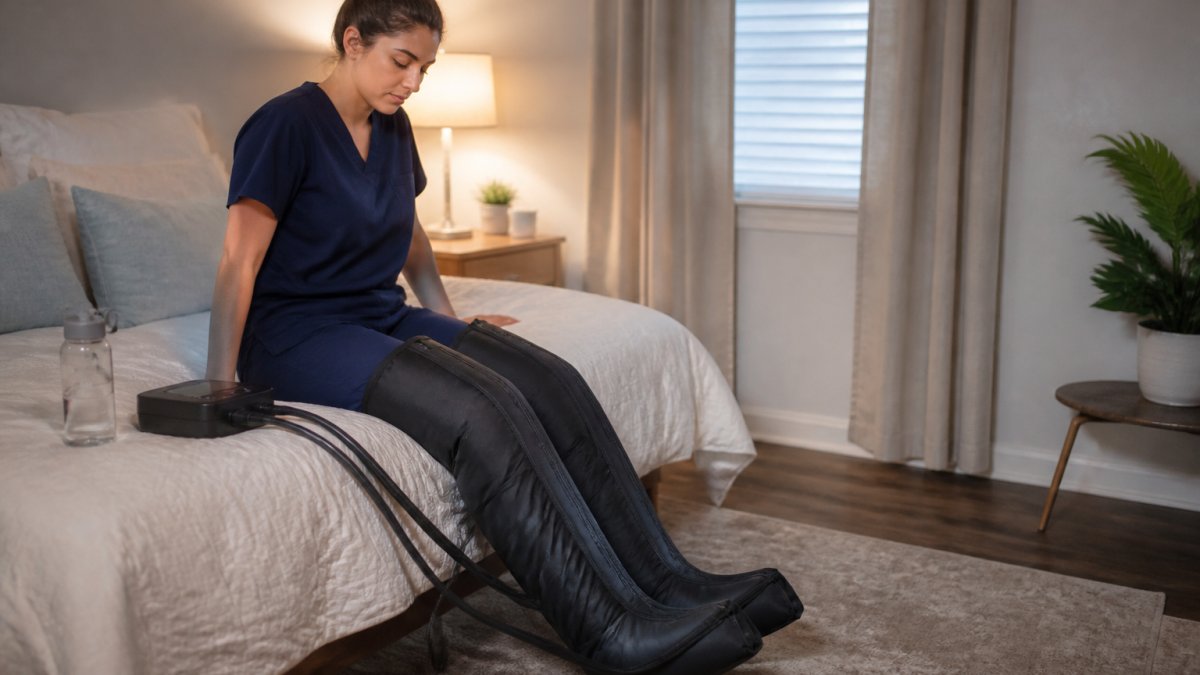
Compression boots are full-leg sleeves that inflate in sequence to push fluid out of your legs and encourage blood flow. They don't fix an injury, and they don't replace medical care for a diagnosed condition.
Sequential Air Compression, Explained Simply
Sequential air compression works by inflating separate air chambers from the foot upward in a wave. Each chamber squeezes, holds, then releases, which mimics the natural muscle pump your legs use when you walk.
That wave action is why the boots feel like a massage rather than a tight bandage. The pressure moves, so it keeps encouraging flow instead of just squeezing one spot.
The Limits of the Evidence for Occupational Leg Fatigue
Here's the honest part: most research on compression therapy looks at post-surgical recovery and athletic recovery, not at nurses on a 12-hour roster. The evidence for shift-related leg fatigue specifically is thinner than the marketing suggests.
That doesn't mean it doesn't help. It means we should be careful about promising a clinical cure for a work-related problem. A common approach among healthcare workers is to treat boots as a comfort and recovery tool, not a treatment.
Compression Boots vs Compression Socks for Tired Legs
Compression boots and compression socks do different jobs, and the right choice depends on when you need help.
Compression socks apply steady, graduated pressure all shift. You wear them while you work, and they help control swelling as it happens. Boots apply dynamic, sequential pressure after your shift, when you're off your feet and can actually relax.
| Feature | Compression Socks | Compression Boots |
|---|---|---|
| When you wear them | During your shift | After your shift |
| Pressure type | Static, graduated | Sequential, dynamic |
| Best for | Preventing daytime swelling | Unwinding heavy legs |
| Effort required | None once on | 20-40 minutes seated |
| Portability | Pocket-sized | Packable, needs power |
Many nurses use both. Socks manage the shift, boots handle the aftermath.
How Long to Use Compression Boots After a Shift
A typical session runs 20 to 40 minutes, but the right number depends on how long you were on your feet and how your legs feel. The table below is a practical starting point rather than a prescription, adjust up or down based on comfort.
| Shift length | Suggested session | Pressure starting point | Frequency |
|---|---|---|---|
| 8 hours | 15-20 minutes | Low to moderate | After most shifts |
| 10 hours | 20-30 minutes | Low to moderate | After every shift |
| 12 hours | 30-40 minutes | Start low, build if comfortable | After every shift, plus a shorter session on the day after |
| Rest day after a run of shifts | 15-20 minutes | Low | Optional, if legs still feel heavy |
A few principles sit behind those numbers:
- Start lower than you think you need. The first two or three minutes should feel like a firm massage, not a squeeze. If you're tensing up, drop a level.
- Longer isn't automatically better. Beyond about 40 minutes, most people stop noticing a difference and the session starts eating into sleep, which matters more for recovery than an extra ten minutes of pressure.
- Frequency beats intensity. A 20-minute session after every shift will do more for heavy legs than one long session on a rest day.
- Split sessions are fine. If 40 minutes in one go feels like a chore, two 20-minute sessions, one right after your shift, one before bed, work just as well for most people.
If you've just finished a brutal shift, start at a lower pressure setting and a shorter session. If your legs feel fine, a longer session at a moderate setting is reasonable. There's no benefit to pushing max pressure just because it exists.
The VYRO Full Leg Massage Boots run 9 pressure levels and 6 massage modes, with built-in heat, so you can dial in a gentler session after a long day or something firmer on a rest day.

Compression Boots Safety and Contraindications
Compression boots are not safe for everyone, and this is the section most articles skip. The reason is mechanical: sequential air compression deliberately moves fluid out of the legs and back toward the heart. That's helpful for a healthy circulatory system and potentially harmful when something is already blocking or straining that flow.
When to avoid boots without medical clearance
Do not use compression boots, and speak to a clinician first, if any of the following apply:
- Known or suspected deep vein thrombosis (DVT). Pressure over an untreated clot can dislodge it. This is the single most important contraindication.
- Severe peripheral artery disease. If arteries are already narrowed, external pressure can further reduce blood supply to the foot and lower leg.
- Uncontrolled heart failure. Pushing a larger volume of fluid back into central circulation can overload a heart that is already struggling.
- Active infection, open wound, or recent surgery in the leg. Pressure over damaged tissue risks worsening the problem.
- Severe peripheral neuropathy with reduced sensation. You may not feel pressure that is too high, which raises the risk of skin damage.
When to check with a clinician first
A conversation with your GP, practice nurse, or an occupational health contact is sensible if you have:
- Diabetes, particularly with any loss of sensation in the feet
- Fragile, thin, or easily damaged skin
- A history of blood clots, varicose veins, or circulation problems
- A current pregnancy, compression needs can change across trimesters, and the appropriate pressure and duration are worth confirming
- Any implanted device where your clinician has previously advised caution around pressure therapy
Warning signs during a session
Stop the session and seek advice if you notice:
- Numbness, tingling, or a pins-and-needles feeling that doesn't fade when the boots deflate
- Sharp pain, particularly in the calf
- Skin that turns unusually pale, blue, or blotchy
- Redness, heat, or swelling that wasn't there before the session
- Shortness of breath or chest pain, seek urgent care rather than waiting
This isn't a scare tactic. It's the same logic as any recovery device: pressure therapy moves fluid, and moving fluid is exactly what you don't want to do around an untreated clot.
Leg Recovery Tips for Nurses: Building a Shift Routine
The best routine is one you'll actually do when you're exhausted. Build it around your shift, not around an ideal version of your day.
- Before your shift: Put on compression socks if you use them, and do two minutes of ankle circles and calf raises.
- During your shift: Take your breaks off your feet, not standing in the break room. Elevate your legs if you can.
- Right after your shift: Change out of work shoes, drink water, and put your legs up for ten minutes before you do anything else.
- At home: Run a 20 to 40 minute boot session while you eat dinner or watch something. Pair it with a warm shower if your legs feel tight.
- On rest days: A shorter session still helps if you've been on your feet the day before.
Choosing Boots: Fit, Features and What You'll Pay
Fit and features matter more than brand names. A boot that doesn't cover foot to upper thigh won't move fluid through the full leg, and one that's too tight is uncomfortable enough that you'll stop using it.
Look for:
- Full-leg coverage from foot to upper thigh
- Adjustable pressure settings, ideally several levels
- A rechargeable, wireless design if you want to use it anywhere
- Reinforced zips and technical fabric if you'll use it daily
- A clear returns window and warranty
Our VYRO Full Leg Massage Boots cover foot to upper thigh, run on a rechargeable battery for up to 6 hours, and charge fully in about 2 hours. At $299.99, they sit well below the price of many recovery systems, and they come with a 1-year warranty and 14-day returns.
Conclusion
Nurse leg fatigue is a real, repeating problem, and no device erases a 12-hour shift. What you can control is what happens after it.
At VYRO, we built our Full Leg Massage Boots for exactly this: full-leg coverage from foot to upper thigh, 9 pressure levels and 6 massage modes, built-in heat, and a rechargeable design that runs up to 6 hours. No appointments, no setup, just a session when you get home, backed by a 1-year warranty and 14-day returns.
Shop now and give your legs the reset they've earned.
Frequently Asked Questions
Can nurses use compression boots after a long shift?
Yes. Compression boots are a recovery tool you use after your shift, not during it, so they don't interfere with patient care or workplace hygiene rules. Most nurses use them at home once they're off their feet, often while watching TV or eating dinner. If you have a circulatory condition, a clotting disorder, or recent surgery, check with your doctor before starting. Otherwise, a 20-30 minute session at a comfortable pressure is a reasonable way to wind down heavy legs.
Are compression boots better than compression socks for tired legs?
They do different jobs. Compression socks apply constant pressure and are worn during your shift, which suits nurses who stand for 12 hours and want support while working. Compression boots use sequential air chambers to massage the leg after the fact, which many people find more relaxing and better for that heavy, tight end-of-day feeling. A practical approach is socks on shift, boots at home. If you only buy one, boots give you a session you can actually feel.
How long should you use compression boots after work?
Most sessions run 15-30 minutes. Start at 20 minutes on a low-to-mid pressure setting and see how your legs feel the next morning. If you worked a double or your legs are unusually swollen, a second 15-minute session later in the evening is fine. Longer isn't automatically better, and running a 60-minute session at maximum pressure won't speed things up. Consistency across the week matters more than one long session.
When should you avoid using compression boots?
Skip them if you have an active blood clot or a history of deep vein thrombosis, severe peripheral arterial disease, untreated heart failure, an open wound or skin infection on the leg, or a recent fracture or surgery without clearance. Pregnancy-related circulation concerns and lymphoedema also need a doctor's sign-off first. If a session causes pain, numbness, tingling or skin changes, stop and get medical advice rather than pushing through.
This article is general information only and is not medical advice. Speak to your doctor before using compression therapy if you have a circulation condition, a blood clot, or any diagnosed medical issue.